
Nguyên liệu chính, Plant-Based Conner, Sản xuất, News
Lemit Foods: When FoodTech Meets ClimateTech from Mekong Young Jackfruit
The future of food will not be shaped only by the question: “What do we eat?”
It will be shaped by bigger questions:
Where do ingredients come from?
How much carbon does the value chain create?
Do farmers capture more value?
Are by-products wasted or reused?
Can food manufacturers reformulate more easily?
And can every meal contribute to a more sustainable food system?
This is where Lemit wants to play a role.
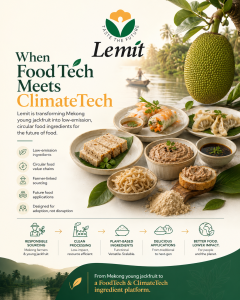
Lemit does not see young jackfruit merely as a local ingredient. We see it as a FoodTech and ClimateTech opportunity: transforming a familiar agricultural biomass from the Mekong Delta into a low-emission, circular ingredient platform for the future food industry.
From Food Products to an Ingredient Platform
In its early stage, Lemit has developed young jackfruit-based products such as spring rolls, dumplings, Vietnamese-style plant-based loaf, pâté, and other plant-forward applications. But Lemit’s journey does not stop at creating a few new food products.
What Lemit is building is a young jackfruit ingredient platform.
Young jackfruit has a naturally fibrous structure, with the potential to provide bite, juiciness, binding, and familiar food textures. When processed properly, it can become a functional ingredient that helps food manufacturers develop lower-meat, fibre-rich, and plant-forward products without requiring major changes to existing production lines.
In other words, Lemit is not only creating finished products for consumers. Lemit is developing the ingredient layer between agriculture and modern food manufacturing.
That is where FoodTech meets ClimateTech.
FoodTech: Rethinking How Food Is Made
FoodTech is not only about creating new dishes. It is about using food science, processing technology, data, product design, and market understanding to create food that is better, more consistent, safer, and more scalable.
For Lemit, the real challenge is not simply “making food from jackfruit.” The real challenge is:
Turning young jackfruit, a naturally variable agricultural material, into a stable ingredient.
Controlling fibre structure, moisture, bite, juiciness, and sensory quality.
Standardizing quality across production batches.
Designing ingredients suitable for multiple applications such as spring rolls, dumplings, meatballs, sausages, structured fillings, ready meals, and blended food products.
Supporting OEM customers in testing, evaluating KPIs, and improving formulations.
That is Lemit’s FoodTech logic: not just selling products, but creating an ingredient system that can work in real manufacturing conditions.
ClimateTech: Reducing Emissions Across the Food Value Chain
The food industry is deeply connected to climate change. From farming, livestock, logistics, processing, packaging, to food waste, every stage leaves a climate footprint.
In this context, ClimateTech in food does not always have to begin with distant or complex technologies. Sometimes, it starts by rethinking undervalued resources within local agricultural value chains.
For Lemit, young jackfruit from the Mekong Delta can become a lower-emission ingredient resource that helps:
Make better use of local agricultural biomass.
Reduce waste across the value chain.
Create additional income opportunities for farmers.
Develop ingredients that support lower-meat and plant-forward products.
Connect traceability, circularity, and low-emission storytelling with B2B/OEM customers.
Build ESG, MRV, and LCA data for more sustainable food systems.
ClimateTech here is not only about a “green product.” It is about redesigning the value chain so that every kilogram of raw material creates more value and less waste.
Why Young Jackfruit?
Young jackfruit is a remarkable ingredient.
It is deeply connected to Vietnamese agriculture.
It has a natural fibrous structure.
It absorbs seasoning well.
It can work across many food applications.
It fits well with Asian food formats.
It has the potential to become a structural ingredient for future food products.
While many future food solutions focus heavily on protein, Lemit sees another important gap: the food industry does not only need protein; it also needs structure.
A good food product is not defined only by protein content. It needs bite, chew, juiciness, water-holding capacity, mouthfeel, and compatibility with food manufacturing processes.
That is why Lemit positions young jackfruit not merely as a replacement ingredient, but as a fibre-rich structural ingredient that can work together with plant proteins, blended meat, or lower-meat formulations.
Designed for Adoption, Not Disruption
One of Lemit’s core principles is:
Designed for adoption, not disruption.
Many new food solutions fail not because the idea is weak, but because they are too difficult to adopt. Factories do not want to redesign production lines. R&D teams do not want overly complicated formulations. Procurement teams do not want ingredients that are too expensive. Consumers do not want products that feel too unfamiliar.
That is why Lemit takes a practical path: developing ingredients that can be used in familiar food formats such as spring rolls, dumplings, Vietnamese-style loaf, pâté, structured fillings, meatballs, sausages, and foodservice products.
Instead of forcing the market to change too quickly, Lemit works within familiar applications and enables gradual, scalable change.
From the Mekong Delta to the Future Food Market
The Mekong Delta is under increasing pressure from climate change, saline intrusion, land subsidence, changing water systems, and agricultural livelihood risks. But this region also has rich biomass resources, farming knowledge, culinary heritage, and strong innovation potential.
Lemit wants to tell a new story for Mekong agricultural products:
Not only raw commodity sales.
Not only local food products.
Not only low-cost competition.
But upgrading agricultural resources into higher-value ingredients, with stronger sustainability narratives, better traceability, and the ability to enter modern food supply chains.
It is a journey from local agriculture to FoodTech ingredients.
From Mekong biomass to ClimateTech solutions.
From one young jackfruit to a low-emission food value chain.
Who Is Lemit in the Future Food Movement?
Lemit does not want to be seen only as a plant-forward food brand.
Lemit aims to be positioned as a Vietnamese FoodTech x ClimateTech company, starting from young jackfruit in the Mekong Delta.
A FoodTech company because Lemit develops processing know-how, functional ingredients, product applications, and solutions for B2B/OEM customers.
A ClimateTech company because Lemit is building a lower-emission value chain, making better use of local biomass, reducing waste, supporting farmers, and developing sustainability data for the food industry.
A Vietnamese innovation company because Lemit starts from a resource that is deeply local, deeply Mekong, and deeply familiar — but views it through a new lens.
The Future Can Begin with Something Close to Home
The future of food does not always have to begin in a distant laboratory or with highly complex technology.
Sometimes, it begins by looking at a young jackfruit with a new question:
What if this is not just an agricultural product, but a low-emission structural ingredient?
What if we do not only sell food products, but build an entire value chain?
What if food innovation can also reduce waste and create more value for local agriculture?
That is the journey Lemit is pursuing.
Lemit Foods – from Mekong young jackfruit to a FoodTech and ClimateTech ingredient platform for the future of food.
 English
  Vietnamese